This review contains slight spoilers.
[When big-hearted but dimwitted Portuguese soccer hunk Diamantino blows it in the World Cup finals, he goes from superstar to laughing stock overnight. His sheltered worldview is further shattered after learning about the European refugee crisis and he resolves to make amends by adopting an African refugee – only to find that his new “son” is actually an undercover lesbian tax auditor investigating him on the suspicion of corruption. From there, Diamantino gets swept up in a gonzo comic odyssey involving cigarette-smoking evil twins, Secret Service skullduggery, mad science genetic modification, and a right-wing anti-EU conspiracy.]
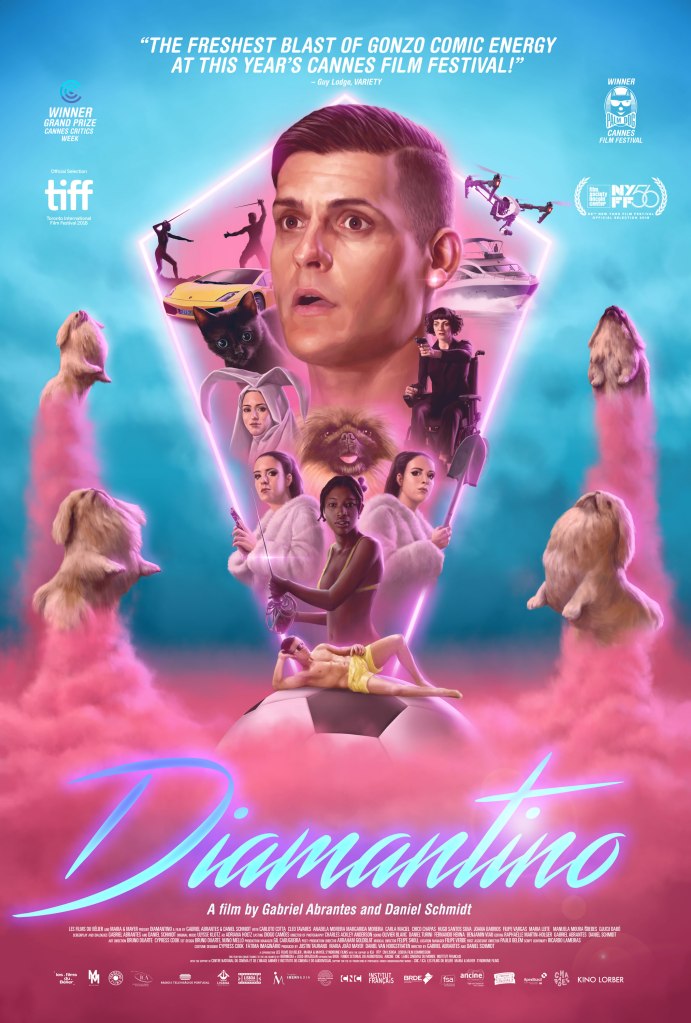
So reads Kino Lorber’s synopsis of this wonderfully delirious satirical comedy. Best of all, despite indications from the theatrical release poster, is that the film tells a surprisingly coherent story. While the filmmakers, Gabriel Abrantes and Daniel Schmidt, did not hesitate to wear their politics of various issues on their sleeve, they also did not simply throw those disparate elements onto a wall to see what would stick. This is a very thoughtful, assured film and probably the film Orson Welles was trying to make when he did Citizen Kane but he unfortunately ended up with something about newspapers and loneliness or whatever.

You may have some reservations, but this is not one of those intentionally bad movies designed to get you and your friends out to a midnight screening to join a crowd of hecklers. Diamantino, in all its camp and whimsy, is incredibly earnest and sincere. Even though Diamantino Matamouros (Carloto Cotta) is childlike in his innocence – whenever he is about to score, he has visions of glittery pink fog and an army of giant Pekingese puppies covering the pitch to support him – and lack of world experience, the humor at his expense comes from parody of celebrity culture, such as him sleeping on a bed with a duvet and pillow covers displaying his likeness. His portrayal, abs and haircut included, makes several pointed references to the exaggerated public image of Cristiano Ronaldo, who also hails from Portugal. Much of the humor, particularly from the villains, is comprised of outrageously coarse punchlines and gags that will have you laughing before the discomfort at the subject matter sets in. This is especially so for Diamantino’s twin sisters Sonia and Natasha (played by sisters Anabela and Margarida Moreira, respectively), whose only limit to their cruelty is when they need to be nice to their naive brother to manipulate him further.
Notable highlights are the beginning in the movie when the Matamouros family patriarch Chico (played by Chico Chapas) has a stroke and dies just before Diamantino’s all-important penalty kick that could tie the game with Sweden; Diamantino had been injured beforehand by a tackle, prompting the sisters to scream at their television that he was faking it. Chico defends his son, while his daughters take to lashing out. When Chico falls over on the couch, his daughters continue to berate him, yelling, “He’s taking a dive, like his son.” Ouch. Seconds later, when Diamantino misses his penalty kick, the immediate reaction from his sisters is, “Fuck you, Diamantino” and the relationship spirals downward from there. The following gag from them as Diamantino spreads his father’s ashes is even better but I won’t spoil it because it’s quick.
The depths of the twin sisters’ maniacal-but-never-cartoonish evil is mined hilariously when, as Diamantino is trying to introduce them to his adopted “son” Rahim, the sisters, trying to chase down a pig in their garden to slaughter it, exclaim “Everyone is kicking refugees out, and you bring one into our house? What the hell has gotten into you?” It’s very clear who and what the film is satirizing with these antics. No surprise that the mad scientist-run cloning lab they later sell Diamantino to is actually part of a conservative conspiracy to increase Portuguese nationalism and convince Portugal to vote to leave the EU, a message blatantly broadcasted by the slogan painted on the side of the laboratory’s van which collects Diamantino every morning.
Diamantino himself never mistreats anyone, and as stated before, the jokes centered on him are mocking celebrity. He is a sympathetic character – with a hilariously out of place Azores accent inspired by Carloto Cotta’s personal trainer during the making of the film – because of his optimism and good nature. In one scene, he states he wants to give his adopted son the “royal treatment” which turns out to be merely his favorite snack of “Bongo juice” and waffles topped with Nutella and whipped cream. The soundtrack contributes equally to the comedic tone of the film, with terribly and obviously inappropriate song choices (the score by Adriana Holtz and Ulysse Klotz bounces from EDM to a strange pick of “I Love You Always Forever” by Donna Lewis) setting the stage for supposedly tender scenes. If it were any other film, there’s no way this would work.

Lensed by cinematographer Charles Ackley Anderson (2013’s The Unity of All Things, which was co-directed by Daniel Schmidt with Alexander Carver) in Super 16mm with anamorphic lenses, and shot predominantly with natural light, Diamantino‘s aesthetic recalls 1970s B-movies as well as the more realism-grounded arthouse cinema movements of the world. Many of the handheld shots seem timed perfectly with the awkward moments Diamantino finds himself in. Like everything else with the film, it is a mix that on paper sounds ridiculous, but has resulted in a masterpiece thanks to the competent cast and crew. The widescreen presentation was an excellent choice, and the transfer on KL’s disc has that healthy level of film grain that will be familiar if you know what 16mm film looks like. The film might have worked just as well if it had been shot digitally, but I wouldn’t complain either way.
The few special effects for the pink fog and puppies are intentionally messy and hazy, but the laboratory effects are rendered very well. Gabriel Abrantes and Daniel Schmidt know when to have fun and when to be serious and when to straddle the line between the two. A blend of sci-fi, comedy, and romance, but foremost a political satire about the rise of the extreme right across Europe, and it’s a great satire at that. This film represents cinema as a whole at a peak, and we would probably be fine as a species if there were no more movies after this. Probably.
* If you’re interested, Diamantino won the Grand Prix at the International Critics’ Week of the 2018 Cannes Film Festival.

5/5
Diamantino
96 minutes
2.39:1 AR
In Portuguese with English subs
Written/dir. by Gabriel Abrantes and Daniel Schmidt
Cinematography by Charles Ackley Anderson
Released 4 April 2019
Portuguese, French, Brazilian co-production
Blu-ray Disc from Kino Lorber
 The Seeming and the Meaning
You must be logged in to post a comment.